


Digital Marketing
The Silent Killer of 2026 Local SEO: Missed Calls Demote Your Rankings
The 2026 Paradigm Shift: Beyond the Blue Link In 2026, the search landscape has shifted from
I’m going to tell you something that might sting a little.
A few years back, a roofer in San Antonio came to us after spending $14,000 on Google Ads over four months. He’d hired an agency out of Texas, nice website, catchy ads. They set up his campaigns, sent him monthly reports full of charts and graphs, and every report said things were “improving.” Meanwhile, his phone wasn’t ringing. Fourteen grand, and the guy couldn’t point to a single job that came from it.
When we dug into his account, we found the problem in about five minutes. Half his ad spend was going to clicks from Phoenix and Tucson, cities he doesn’t even serve. The other half was sending people to his homepage, which had no phone number above the fold, no form, no easy way to convert. Just a stock photo of a roof and a paragraph about his “mission.”
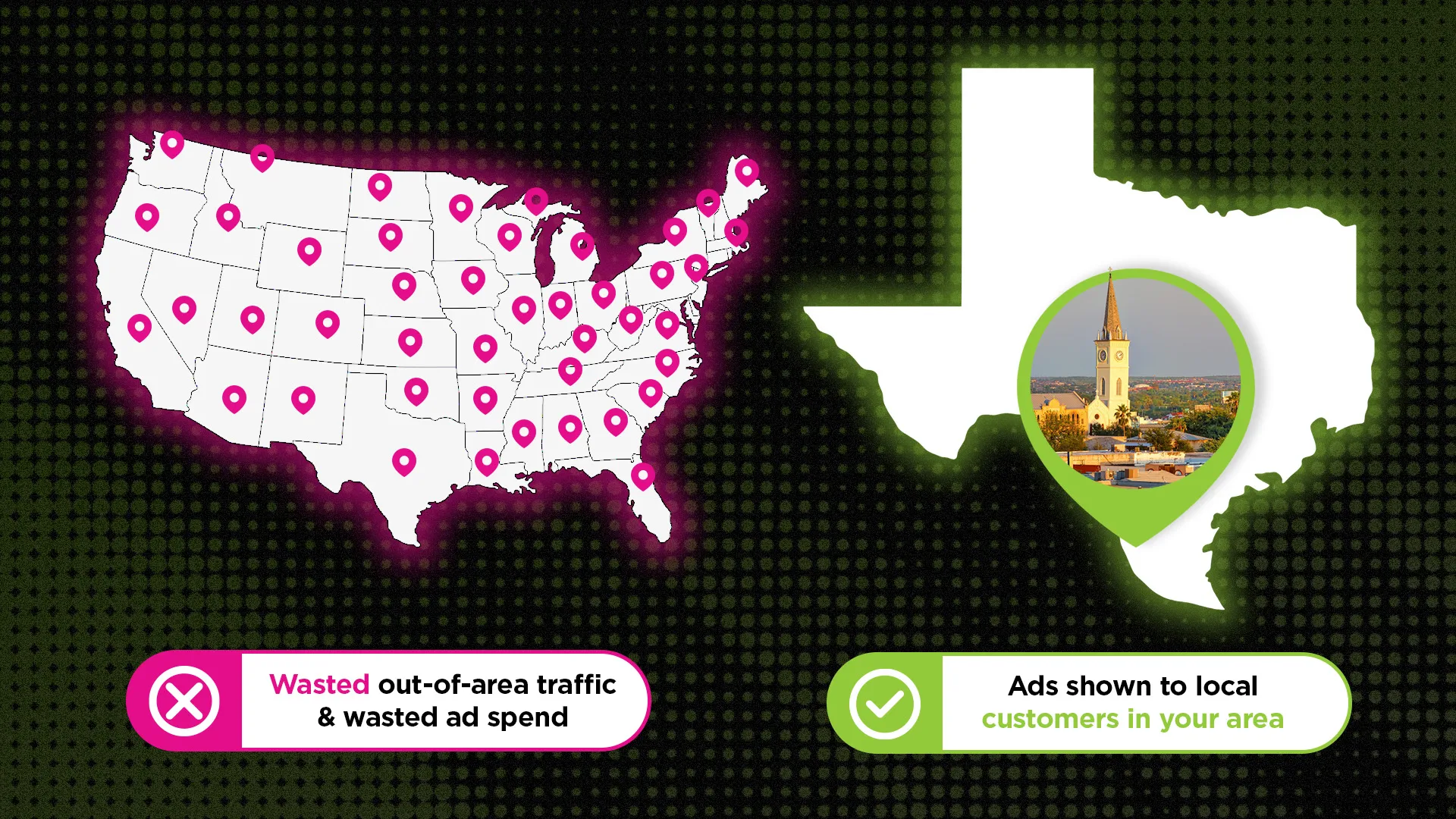
(A lot of business owner forget to exclude locations)
That story isn’t unusual. We hear some version of it almost every week from plumbers, landscapers, auto detail guys, clinic owners, and workshop operators across Texas. They’ve tried Google Ads/ Meta Ads. They’ve dabbled in SEO. Maybe they hired an agency that sold them a package. And the results were… nothing. Or close to nothing.
The problem isn’t that these channels don’t work. They do. The problem is that most agencies treat each one like its own little island. PPC over here. A blog post over there. Maybe some social media thrown in for good measure. There’s no system connecting the dots between the moment a homeowner types “roofer near me” into Google and the moment they actually pick up the phone and call someone.
That’s why we built the Quarter Mile Lead Generation System. And that’s what this article is about—how it works, why we built it the way we did, and why it actually produces results for the kinds of businesses we serve.
This is the thing most agencies get completely wrong, and honestly, it drives me nuts.
A solo plumber running two trucks out of Laredo does not need the same marketing strategy as a 50-truck roofing operation in DFW. It sounds obvious when I say it out loud, right? But go talk to most agencies and they’ll hand both of them the exact same package. Same deliverables, same monthly report template, same strategy deck they’ve recycled for the last 30 clients.
At Quarter Mile Inc., we start every engagement the same way: we look at your business. Not your industry. Your business. How many people are on your team? Who answers the phone when a lead comes in? What’s your capacity to actually handle new work right now? What’s your budget—the real number, not the aspirational one? What does your competition look like in your specific service area?
The answers to those questions determine the strategy. Sometimes that means we start with PPC and funnels because the business needs leads this week, not six months from now. Sometimes it means we focus on SEO and direct mail because the owner has a decent pipeline but wants to dominate their neighborhood over time. Sometimes it’s all four pillars running at once because the business is ready to scale.
There’s another reason this matters more now than it did even two years ago. Google’s Andromeda updates have changed how search actually works. AI is now deciding which businesses to show, which content to trust, and which brands to recommend. The old playbook—stuff some keywords in a blog post and hope for the best—doesn’t cut it anymore. You need an integrated strategy that sends the right signals across multiple channels. And that strategy has to be built around what your specific business can actually execute.
The Quarter Mile Lead Generation System has four parts. We call them pillars because if you remove one, the whole thing gets weaker. They’re designed to work together, not in isolation. Here’s how each one works and, more importantly, why it matters for your business.
SEO is the one everyone’s heard of and nobody fully understands. Half the business owners we talk to think it means “put some keywords on my website.” The other half think it’s dead because “someone told them AI is replacing Google.” Neither of those things is true.
Here’s what SEO actually means for a local service business in Texas in 2026:
Your Google Business Profile has to be dialed in. I mean really dialed in, accurate categories, full service descriptions, photos updated regularly, and a consistent stream of reviews coming in.
For plumbers, roofers, landscapers, and auto detail shops, the Map Pack (those three business listings that show up at the top of a local search) is where the majority of high-intent leads come from. If you’re not showing up there, you’re invisible to the people who are ready to hire right now.
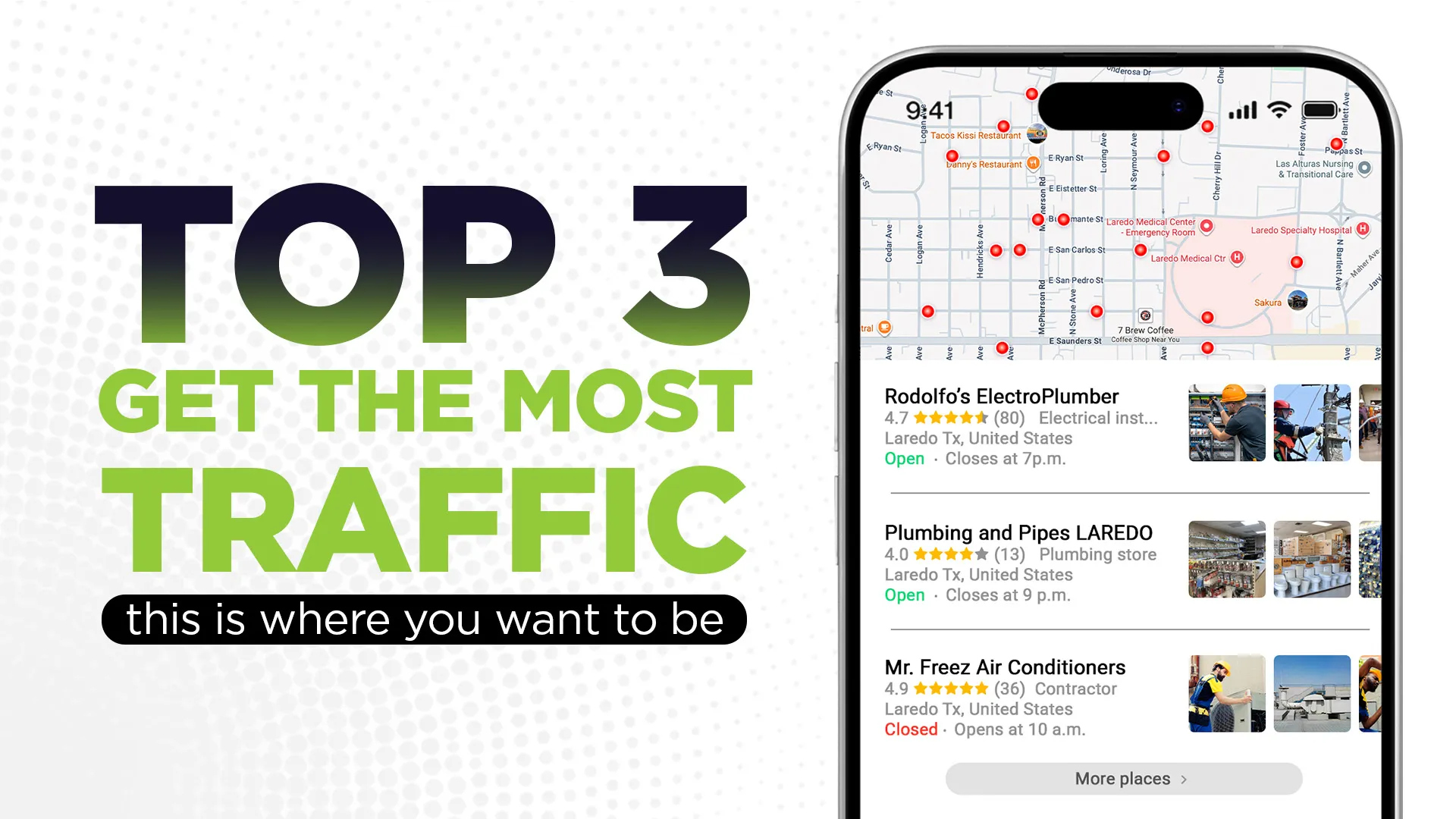
(This is how the Map Pack looks like)
Then there’s content. And no, I don’t mean generic blog posts like “5 Tips for Choosing a Plumber.” I mean location-specific service pages that answer the exact questions your customers are asking. A landscaper in San Antonio needs different content than one in Laredo. Different neighborhoods, different competitors, different seasonal patterns. We build content that positions your business as the local expert—not just another website with stock photos and filler text.
And then there’s the technical side: page speed, mobile responsiveness, schema markup, site architecture. The stuff nobody sees but Google definitely notices. With the Andromeda updates, AI systems are increasingly favoring websites that load fast, work perfectly on a phone, and are structured in a way that machines can easily understand. We handle all of that so you don’t have to think about it.
The goal of SEO in our system isn’t just to “rank.” It’s to build a digital asset that generates leads organically, month after month, so you’re not 100% dependent on paid ads to keep the phone ringing.
SEO is the long game. Pay Per Click is the “I need leads this week” game. For local service businesses, Google Ads and Local Services Ads are the fastest way to get in front of homeowners who are actively searching for what you do.
But remember that roofer from Laredo I mentioned? PPC is also the fastest way to burn money if it’s set up wrong. Here’s how we do it differently:
We geo-target to the zip code level. If you’re a plumber in Laredo, we’re not wasting your budget on clicks from people in Houston who will never hire you. We’ve run campaigns where we literally target different neighborhoods with different ad copy because the competition and the customer profile are different on the north side of town versus the south side.
We separate high-intent keywords from research keywords. Someone searching “emergency plumber near me” is about to call. Someone searching “how to fix a leaky faucet” is trying to DIY. Both searches are relevant, but they need different ads, different landing pages, and different budgets. We don’t lump them together.
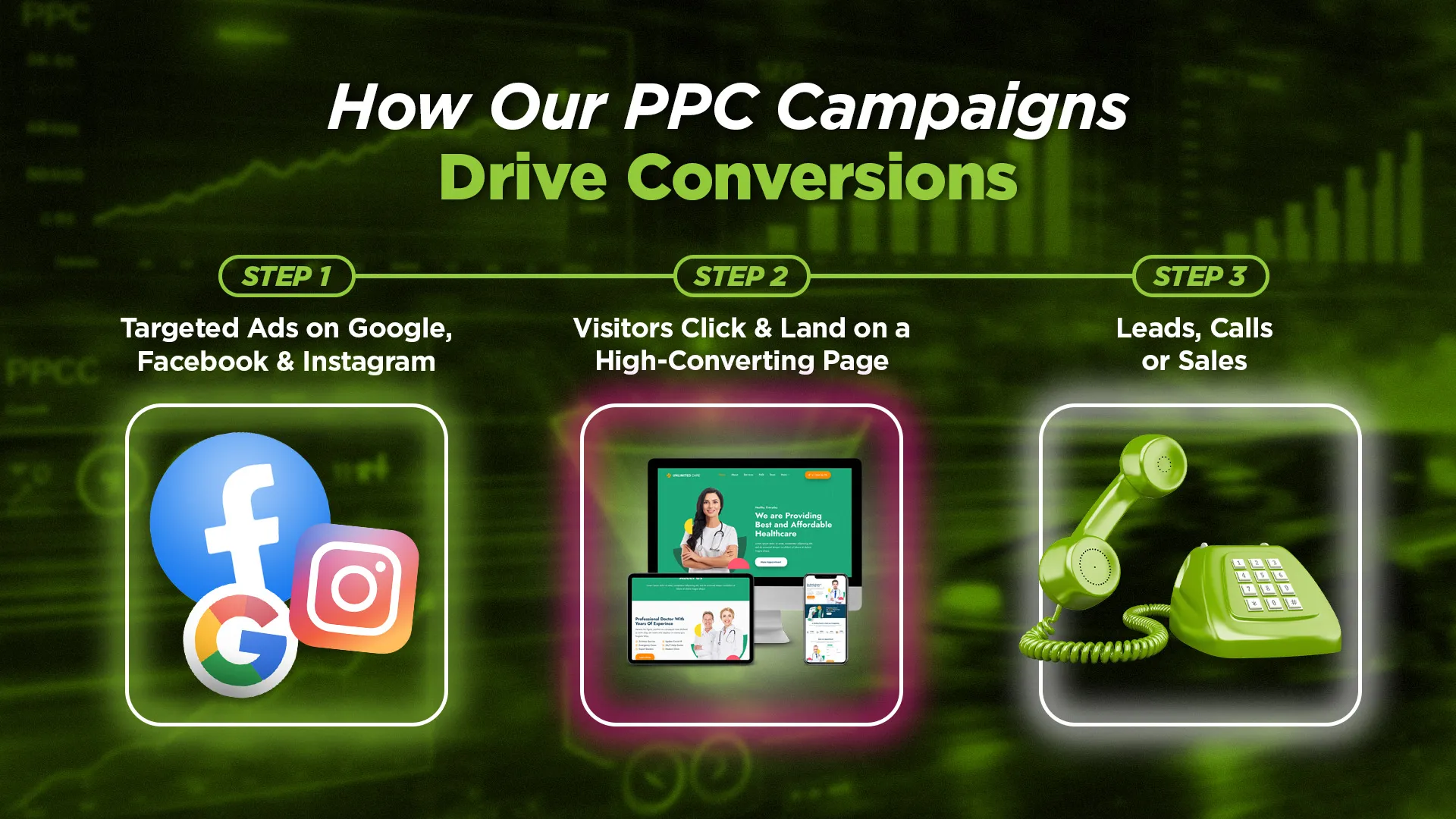
And here’s where the system really clicks, no pun intended. Our PPC campaigns don’t send people to your homepage. They send them to a dedicated conversion funnel (that’s Pillar 3) that’s specifically designed to turn that click into a phone call or a booked appointment. That connection between the ad and the funnel is what makes conversion rates go from “meh” to “holy crap.”
We also manage campaigns daily. Not monthly. Not “whenever we get around to it.” Daily. Bids get adjusted, bad keywords get killed, ad copy gets tested. Because at $15 to $40 a click for some local service keywords in Texas, you can’t afford to let a campaign run on autopilot.
This is the pillar that most agencies completely ignore, and honestly, it’s the one that makes the biggest difference.
Think about it. You spend money on SEO to drive organic traffic. You spend money on Google Ads to drive paid traffic. And where does all that traffic go? To your website. Which is… an About Us page, a Services page, a photo gallery, and a contact form buried at the bottom that half the people never scroll to.
That’s like paying for a thousand people to walk into your store and then not having a cash register.
A conversion funnel is a purpose-built page (or short sequence of pages) designed to do one thing: get the visitor to take action. For a plumber, that means booking a service call. For an auto detail shop, that means scheduling an appointment. For a clinic, that means filling out an intake form.
Here’s what goes into our funnels:
They’re fast. Like, really fast. If your page takes more than three seconds to load on a phone, you’ve lost half your visitors. Local customers searching for services are not patient people. They’ve got a leak, a busted AC, or a car that looks like it went through a dust storm. They want to call someone now.
They’re loaded with trust signals. Reviews, testimonials, before-and-after photos, licensing badges, insurance info. A homeowner in Texas isn’t going to call a plumber they found on Google unless they trust them. Our funnels establish that trust in the first five seconds.
The follow-up is automatic. This is huge. When a lead comes in, they don’t sit in an inbox waiting for someone to notice. Our systems fire off a text, an email, and a notification to your team within seconds. We’ve seen studies showing that responding within five minutes makes you 100 times more likely to actually close the lead. Five minutes. Most businesses take five hours.
Everything is tracked. Every funnel is wired with conversion tracking so we know exactly which channel, which campaign, and which keyword produced each lead. That data feeds back into the SEO and PPC strategies. It’s a loop that keeps getting smarter over time.
Without this middle layer, you’re leaking money. Your SEO is generating clicks that bounce. Your PPC budget is producing visits that go nowhere. The funnel is what turns traffic into actual, callable, bookable leads.

I know what you’re thinking. “Direct mail? In 2026? Are you serious?”
Dead serious!. And here’s why.
Think about your own life for a second. How many emails did you get today? How many ads did you scroll past on Instagram? How many pre-roll ads did you skip on YouTube? Now think about the last time you got a well-designed postcard in the mail from a local business. It probably sat on your kitchen counter for a couple days. Maybe you showed it to your spouse. Maybe you stuck it on the fridge.
That’s the power of physical mail. It cuts through the noise in a way that digital ads simply can’t anymore. And for local service businesses in Texas, it works really well. Here’s how we use it:
We don’t blast every address in a zip code. We use data, property records, homeowner demographics, home age, even weather patterns, to target the households most likely to need your service. After a hailstorm hits a neighborhood in the Rio Grande Valley? Our roofing clients have mailers landing in those mailboxes within days. A new subdivision in south Laredo with fresh construction winding down? Our landscaping clients are the first ones those homeowners hear from.
Every mail piece includes a QR code or a unique URL that ties back to your conversion funnel. When someone scans it, we know that lead came from direct mail. No guessing. No “well, it’s hard to measure.” We measure it.
And even when a postcard doesn’t generate an immediate call, it builds brand recognition. When that homeowner eventually does need a plumber or a roofer, your name is the one they remember, because they’ve seen your truck on their street, seen your website in a Google search, and found your postcard on their kitchen counter. That’s not one channel working. That’s all four pillars working together.
One of the things that drives business owners crazy—and I hear this constantly—is that their last agency treated them exactly like every other client. Same strategy, same deliverables, same generic monthly call where someone reads a spreadsheet at them for 20 minutes.
The Quarter Mile Lead Generation System is modular. Not every business starts with all four pillars running full blast. Here’s how we typically think about it:
We might kick off with PPC and funnels to get leads flowing immediately while we lay the SEO foundation in the background. Direct mail comes later once there’s revenue to reinvest. We’ve started plumbing companies this way that were running one truck and within a year needed three because the leads were consistent enough to hire.
If you’ve got a steady business and you want to dominate your market, we deploy all four. SEO and PPC for consistent volume. Funnels to maximize every visitor. Direct mail to hit the neighborhoods your digital campaigns can’t reach—the homeowner who doesn’t Google, who doesn’t use Yelp, but who absolutely opens their mailbox every day.
This one’s important, and it’s something that genuinely sets us apart.
We get it. Most local businesses can’t hire a marketing coordinator. Your office manager is already answering phones, scheduling jobs, handling invoices, and putting out fires. Your techs are in the field all day. The last thing you need is some agency handing you a login to five different platforms and saying “good luck.”
That’s why automation is baked into every layer of what we build. Lead follow-up happens automatically. Appointment booking happens automatically. Reporting is a dashboard you can glance at in two minutes, not a spreadsheet you need a degree to read. Your team’s job is to do great work and answer the phone. Our system handles everything between the click and the call.
We build it so the leads flow in, the follow-up fires off, and your people can focus on what they’re actually good at—the work that pays the bills.
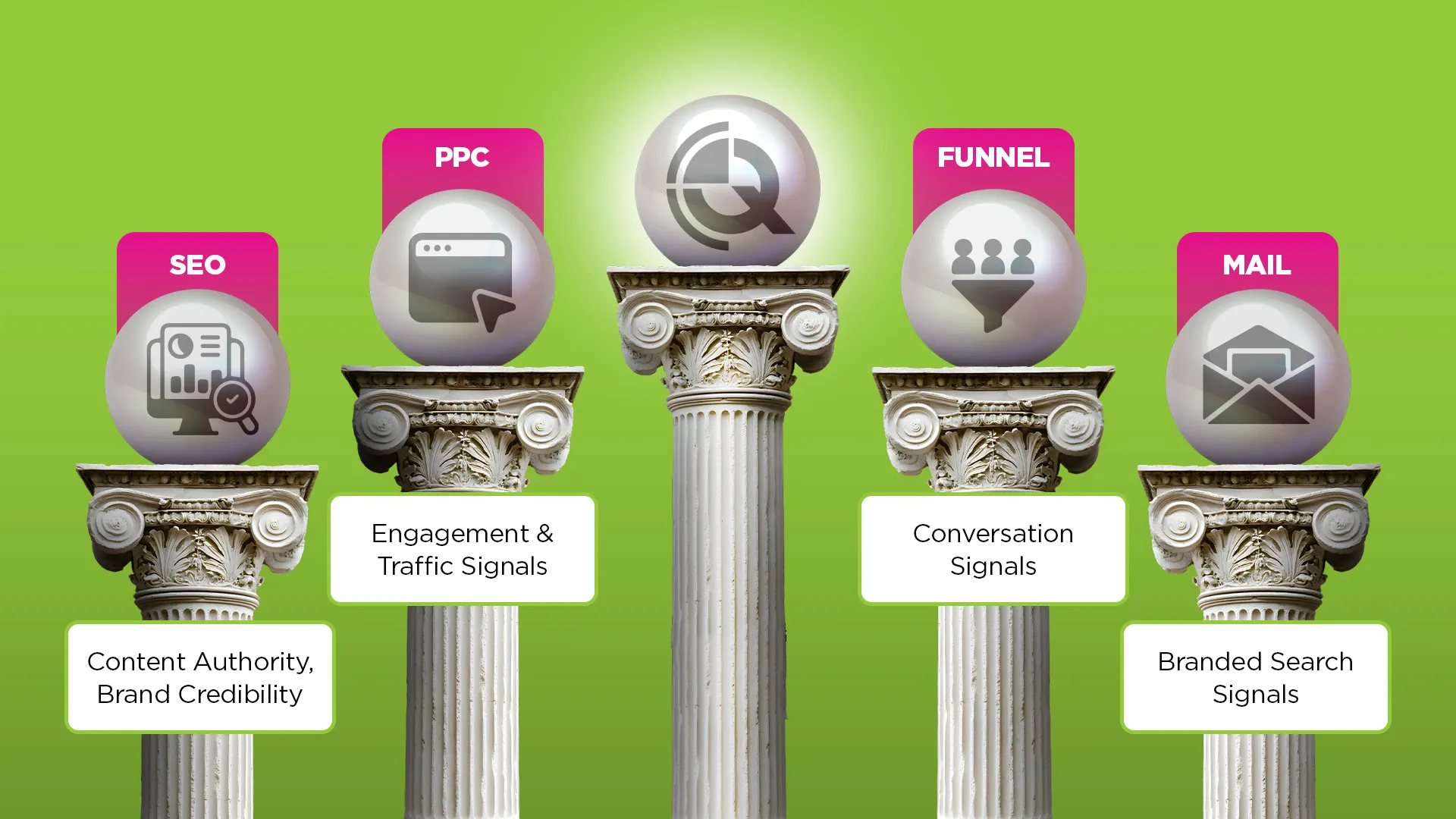
I’m going to be real: the game changed in the last 18 months, and a lot of businesses haven’t caught up.
Google’s Andromeda updates and the explosion of AI-powered search have fundamentally shifted how people find local businesses. It’s not just about keywords anymore. AI systems evaluate your business, your brand, the whole web of signals around you, to decide who to show and who to recommend.
When someone asks an AI assistant “who’s the best roofer in Laredo?” or “find me an auto detail shop in McAllen,” the AI isn’t just looking at your website. It’s looking at your reviews, your Google Business Profile, your content, whether people are searching for you by name, and how many signals across the internet confirm that you’re a real, trusted business.
This is exactly why the Quarter Mile system works the way it does. Each pillar feeds a different signal:
Running one channel is better than nothing. But in 2026, an integrated approach isn’t a luxury—it’s the only way to build the kind of entity signal that keeps your business visible when AI is choosing who to recommend.
Quarter Mile Inc. wasn’t born in a marketing boardroom. It was forged on the front lines of the B2B world.
As a business operating in the same trenches as you, we faced the exact same frustrations: marketing agencies that didn’t understand our margins, lead systems that leaked money, and “solutions” that only added more work to our already busy day. We didn’t set out to start an agency; we set out to survive and scale our own operations.
We built this automation and lead generation system out of necessity. We needed something that worked without constant babysitting—so we built it. When we saw our own revenue climb and our operations smoothen, we realized we had captured lightning in a bottle. We decided to replicate our internal system for other Texas businesses, and the results were undeniable.
Here’s why our “insider” perspective changes everything for you:
We aren’t just selling a service; we’re sharing a blueprint that took us from “struggling to keep up” to “automated and thriving.
Lead generation doesn’t have to be a guessing game. It doesn’t have to mean throwing money at Google Ads and crossing your fingers. And it definitely doesn’t have to mean hiring an agency that treats your plumbing company the same as a SaaS startup in Austin.
The Quarter Mile Lead Generation System is a framework that combines SEO, PPC, conversion funnels, and direct mail into one engine, designed for local service businesses, built around the realities of running a small operation in Texas, and automated so it doesn’t create more work for your already-busy team.
If you’re a local business owner who’s tired of inconsistent leads and agencies that don’t understand your world, we built this for you. We’d be glad to show you how it works.
You now have a solid plan for a successful direct mail campaign in Laredo. In a competitive race, a smart, well-timed mailer can be the piece of communication that truly connects with a voter, and the right partner makes all the difference.
It’s time to move from planning to action.
Book a free meeting with our Laredo experts. No hard sell, just a productive conversation about your goals, questions and needs.
You’ll leave the session with:
The 2026 Paradigm Shift: Beyond the Blue Link In 2026, the search landscape has shifted from

Let’s be honest about the math. If you run a service business in the United States—whether

It’s 2026. From retail spots on San Antonio to logistics providers near the World Trade Bridge,