



Digital Marketing
The Quarter Mile, Inc Lead Generation System
Lead Generation Strategy How We Combine SEO, PPC, Funnels, and Direct Mail to Build Predictable Revenue

We had a client a couple years back—roofing company out of McAllen, seven trucks. Every single one was plain white. No logo, no phone number, nothing. These trucks were driving through neighborhoods six days a week, parking in driveways, sitting at red lights on Expressway 83, and nobody had any idea who they belonged to.
We wrapped all seven. Same design, same colors, same phone number in big bold text across the tailgate. Within 60 days, the owner told us he was getting calls from people saying “I see your trucks everywhere.” He hadn’t changed his routes. Hadn’t hired more guys. His trucks were just finally telling people who he was.
That’s the thing about fleet vehicle wraps that’s hard to explain until you’ve lived it. The OAAA (that’s the Outdoor Advertising Association) says a single wrapped vehicle gets somewhere between 30,000 and 70,000 impressions a day. Sounds like a made-up number, right? But think about your own commute. Think about how many vehicles you see. Now think about the ones you actually remember—it’s always the ones with graphics on them.
Here’s the part that kills me about business owners who are hesitant: you’re already paying for the gas. You’re already paying for the insurance. The truck is already out there driving around. You’re just choosing not to put your name on it.
And meanwhile, your competitor down the road has his logo on every truck, and guess who the homeowner calls when they need a plumber? The guy they’ve seen on their street three times this week.
The other thing—and this is what separates fleet wraps from basically every other kind of marketing—you pay once. That’s it. No monthly fee. No cost-per-click bleeding you dry at $80 a pop. No billboard lease you’re locked into for a year. You wrap the truck, and it works for you for the next three to seven years while you’re busy actually running your business.
Anyway, we wrote this guide because we get the same questions every week from business owners across Texas. What kind of wrap do I need? How much is this gonna run me? Is it worth it? So here’s everything, all in one place.
Not all fleet vehicle wraps are the same, and honestly, not every business needs the same thing. We’ve had guys walk in wanting a full wrap on 15 trucks when what they really needed was good decals and a couple partial wraps. Saved them thousands. So let’s break this down.
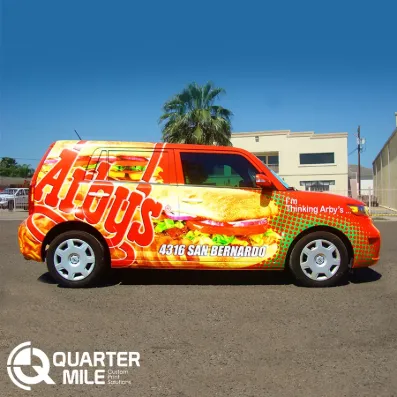
A full wrap means we cover everything—doors, panels, hood, bumpers, and usually the rear window too. The whole truck becomes your brand. It’s the most dramatic option and honestly, it’s the one that turns heads.
We usually recommend full wraps for companies that want their fleet to look identical. If you’ve got trucks that are different colors or different years and they look like a mismatched mess, a full wrap fixes that instantly. Suddenly your whole fleet looks like it rolled off the same lot. It also covers up door dings, scratches, and faded paint—so your ten-year-old F-150 looks brand new.

This is probably our most popular option for Texas fleet owners, and I’ll tell you why: it gets you about 80% of the visual punch at maybe 55% of the cost. We wrap the rear quarter, the sides, sometimes the tailgate—and leave the base paint showing where it makes sense.
If your trucks are white (and let’s be real, half the work trucks in Texas are white), partial wraps look incredible. The white acts as a clean background and the graphics pop. We did a fleet of eight landscaping trucks in San Antonio like this and the owner said people kept asking if he got new trucks. Nope. Just wrapped them.
Fleet vehicle graphics with partial wraps work especially well when you’re scaling. You can wrap the truck you’re buying this year and it still matches the ones you wrapped last year. That consistency matters more than people think.
Custom fleet decals are your entry point. Logo on the doors, phone number on the tailgate, maybe your website on the rear window. Simple, clean, professional. And honestly? For some businesses, this is all you need.
We tell guys who are just starting out or who lease their trucks—go with decals first. They’re quick to produce, quick to install, and if you swap out a truck, removing them isn’t a big deal. You can get a whole vehicle done for a few hundred bucks instead of a few thousand.
The tradeoff is obvious: less coverage means less impact. But a truck with clean, professional decals looks 100 times better than a plain white truck with a magnetic sign flopping around on the door.

Probably the most underrated option out there. A rear window wrap goes on the back glass with perforated vinyl—so it looks like a full-color graphic from outside, but the driver can still see through it from the inside. And here’s the thing: who’s behind your truck in traffic? Every single person staring at your tailgate while they wait at the light on 83 or sit on I-35.
We’ve had auto detail guys add a rear window wrap showing a before-and-after of their work, with a big phone number underneath. Cost them under $300. That’s about as cheap as marketing gets.

If you are a solo entrepreneur or a professional using your personal vehicle for a new venture, vehicle magnets are one of the smartest investments you can make. They provide the perfect balance between a professional image and the flexibility your lifestyle requires.
For many starting out, the “work truck” is also the “family SUV.” Magnets allow you to switch from business mode to personal mode in seconds. They are the ideal solution for weekend projects, side hustles, or testing out a new brand identity before committing to a permanent wrap.
| Type | Coverage | Impact | Lifespan | Best For |
|---|---|---|---|---|
| Full Wrap | 100% | Highest | 5–7 yrs | Main fleet trucks |
| Partial Wrap | 50–75% | Strong | 4–6 yrs | Best bang for buck |
| Decals | 10–30% | Moderate | 3–5 yrs | Budget / leased trucks |
| Rear Window | Window | High (traffic) | 3–5 yrs | Cheap add-on |
| Magnets | 1–2 panels | Low | 1–3 yrs | Personal vehicles only |
Here’s what we usually tell people. If you’ve got a small fleet—say two to five trucks—and you want them to look sharp, go full wrap. Every vehicle hits the road as a walking advertisement. Worth the spend.
If you’re running ten or more vehicles and you need to keep costs reasonable, partial wraps are the sweet spot. We wrap fleets like this all the time. You get professional, consistent branding without the sticker shock (no pun intended).
Starting out or on a tight budget? Decals. Seriously. Don’t let “perfect” be the enemy of “done.” A truck with good decals is infinitely better than a blank truck. You can always upgrade to wraps later when the revenue comes in.
And honestly, a lot of our clients mix and match. Full wraps on the main service trucks, partial wraps on the crew’s pickups, and decals on the boss’s personal vehicle. Nothing wrong with that.

When people think fleet vehicle wraps, they usually picture pickups and cargo vans. But semi truck graphics? That’s a whole different ballgame, and honestly, it’s one of the biggest untapped opportunities for companies that run trailers.
Think about the numbers for a second. A standard 53-foot trailer has over 500 square feet of flat space on each side. That thing is basically a highway billboard on wheels. And it doesn’t sit in one location—it’s driving through multiple cities, on I-10, I-35, I-20, wherever your routes go. Some industry estimates put a single branded trailer at up to 1.5 million impressions per year. Per year!
But you can’t just wrap a trailer the same way you’d wrap a pickup. Here’s what makes it different:

Trailers take a beating. Highway speeds, road debris flying up at 70 mph, the brutal Texas sun baking vinyl eight hours a day, and all that vibration from the road. Cheap vinyl—the calendered stuff some shops use to save a buck—will start cracking and peeling within a year on a trailer.
We use premium cast vinyl for semi truck graphics. 3M IJ180Cv3 or Avery Dennison MPI 1105 with matched over-laminates. It costs more upfront, but it holds up for five-plus years on the road. We’ve seen the other stuff fail, and trust me, a half-peeled trailer wrap looks way worse than no wrap at all.
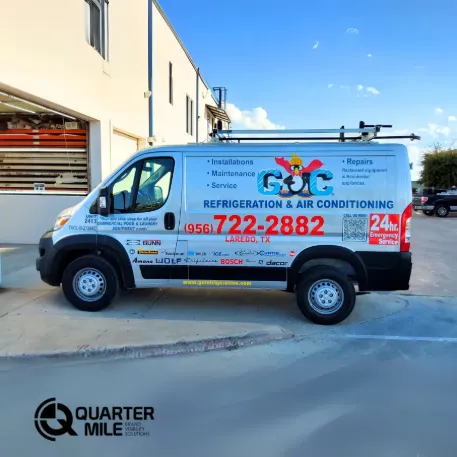
People see semi trailers from 50, 100, 200 feet away at highway speed. You’ve got maybe two seconds to make an impression. That means big logos, bold colors, minimal text, and high contrast. We’ve had clients come in wanting to cram their full services list, mission statement, and seven phone numbers on a trailer. We talk them out of it. Every time.
The other thing—most trailer walls are corrugated. They’ve got rivets and seams running across the surface. If you don’t design around those, your logo ends up looking like it went through a paper shredder. An experienced designer maps the physical surface and adjusts the layout so the key elements sit clean.
A full trailer wrap takes two to four days. For a fleet that runs tight schedules, that can feel like forever. So what we do—and what any good shop should do—is wrap vehicles in rotation. We take one or two at a time, work around your dispatch schedule, and make sure your fleet is never short-handed because of graphics installation. Some of our bigger projects, we’ve even done night and weekend installs to keep the client’s operation running smooth.
If you’ve never wrapped a vehicle—let alone a whole fleet—it can feel like a black box. So here’s exactly what happens, step by step. No mystery.
We look at your fleet first. How many vehicles? What kind—pickups, box trucks, vans, trailers? What shape are they in? We’ve had guys bring in trucks with dents and rust that needed bodywork before we could wrap them. It’s better to know that upfront than find out the day of installation. We also ask about your goals, your budget, and your timeline so we’re all on the same page before any design work starts.
Design phase. Our designers mock up your graphics on digital templates of your exact vehicle models. You’ll see what it looks like on the hood, the doors, around the wheel wells, across the tailgate—all of it. We go back and forth on revisions until you’re happy. If you already have brand guidelines, we work within them. If you don’t, this is actually a great chance to lock in a visual identity that looks consistent across everything.
Material selection. This is where we talk vinyl grades. We’ll lay out the options—cast vs. calendered, 3M vs. Avery—and explain the tradeoffs in plain English. Not every vehicle needs the most expensive material, but some definitely do. A highway trailer and a pickup that barely leaves town have very different needs.
Printing and lamination. Once you approve the design and we’ve picked materials, everything goes to our wide-format printers. After printing, we apply a clear over-laminate that protects against UV, scratches, and the kind of road grime Texas vehicles deal with daily. Production for a typical fleet of five to ten vehicles runs about three to five business days.
Prep. Before anything touches the vehicle, every panel gets cleaned, degreased, and inspected. I know it’s not glamorous, but this step is make-or-break. Any wax, oil, or dirt left on the surface and the vinyl will bubble or lift within months. We’ve seen installs from other shops fail because they rushed this part.
Installation. Certified installers apply the vinyl by hand, using heat guns and squeegees to work the material around curves, recesses, and body lines. A full wrap on a truck or van takes about one to two days. Partials and decals are faster. We do everything indoors in a controlled environment—no dust, no wind, no 105-degree Texas heat messing with the adhesive.
Inspection and handoff. We check every edge, every seam, every corner. The vehicle gets photographed for our records (and yours), and we walk you through care instructions so you know how to keep the wrap looking good for years. Then you’re back on the road.
| 📦 What You Get | 🚚 Per Vehicle | 🏢 Fleet (5+) | 📝 Notes |
|---|---|---|---|
| 🚛 Full Wrap — Truck/Van | $2,500 – $5,000 | $2,000 – $3,500 | Design + install included |
| 🛣️ Full Wrap — 53ft Trailer | $3,500 – $6,000 | $2,800 – $4,500 | Premium vinyl required |
| 🚐 Partial Wrap — Truck/Van | $1,200 – $2,500 | $1,000 – $2,000 | 50–75% coverage |
| 🏷️ Fleet Decals — Per Vehicle | $300 – $800 | $250 – $600 | Logo + phone + website |
| 🪟 Rear Window Wrap | $150 – $400 | $120 – $300 | Perforated vinyl |
| 🚪 Door Signage | $200 – $500/pair | $150 – $400/pair | Cut vinyl on doors |
| 🧲 Car Magnet | $100 – $180/pair | $50 – $90 | Won’t stick to aluminum, plastic, fiberglass, or thick bondo |
Now, a couple things to know about these numbers:
The number you really should care about isn’t the sticker price. It’s the cost per impression over the life of the wrap. And by that measure, fleet vehicle wraps are one of the cheapest forms of advertising you can buy. Period.
Look, I know “ROI” sounds like something a marketing consultant says before handing you a bill. But the math on fleet wraps is so lopsided it’s hard to ignore. Let me show you.
| Channel | CPM (Cost Per 1k Views) | Duration | Cost Type |
|---|---|---|---|
| Fleet Vehicle Wraps | $0.04 – $0.15 | 3–7 years | Pay once |
| Billboard (Texas avg) | $3 – $8 | Monthly lease | Recurring |
| Google Ads (Local Svc) | $15 – $50+ | Per click | Recurring |
| Social Media Ads | $6 – $15 | Monthly | Recurring |
| Direct Mail | $15 – $30 | Per campaign | Recurring |
| Local Radio | $10 – $25 | Per flight | Recurring |
Read that again. Fleet wraps come in at roughly four to fifteen cents per thousand impressions. Google Ads for a local service business in Texas? Fifteen to fifty dollars or more. That’s not a typo. That’s not even the same universe.
A quality fleet wrap lasts three to seven years. Every month that goes by, your effective cost per impression drops. There’s no renewal. No monthly check to write. Your truck is parked at a job site on a Saturday—it’s still advertising. It’s in a Whataburger drive-through—still advertising. Sitting in your driveway overnight in a subdivision full of homeowners—advertising.
Try getting that from a Facebook ad.
This one doesn’t show up on a spreadsheet, but every local business owner knows it’s real. When a homeowner sees your wrapped truck parked at their neighbor’s house, it’s
an endorsement. It says: your neighbor hired this company and they’re right next door doing the work. That kind of implicit trust is worth more than any ad click.
And when that same homeowner sees your truck on their commute to H-E-B the next day, your brand goes from “somebody I saw once” to “oh yeah, those guys are everywhere.” That familiarity is what makes them call you instead of Googling “plumber near me” and picking whoever paid the most for the top ad spot.
Here’s something that surprises people: fleet wraps drive branded searches. Someone sees your truck, can’t call right then, and later that night Googles your company name. That branded search is one of the strongest signals to Google—and to AI search systems like the ones powered by Andromeda—that your business is a real, recognized local entity.
In 2026, with AI increasingly deciding which businesses to recommend, those branded search signals matter more than ever. Your wrapped fleet isn’t just old-school advertising. It’s feeding your digital presence every single day.
I’ll be blunt: there are a lot of shops out there that will sell you a cheap wrap, slap it on in a parking lot, and disappear when it starts peeling six months later. We’ve re-wrapped vehicles from other shops more times than I’d like to count. So here’s what to actually look for.
If they can’t tell you the brand and product line—walk away. The industry standards are 3M and Avery Dennison for fleet-grade cast vinyl. If someone’s quoting you a price that seems too good to be true, they’re probably using economy vinyl that won’t survive a Texas summer. We’ve literally peeled off wraps that were less than a year old because the shop used cheap material to save a few bucks. The customer paid twice
This is non-negotiable. Professional fleet vehicle wraps need to be installed in a clean, climate-controlled space. Dust, wind, and temperature swings cause defects that shorten the life of the wrap. If a shop is doing installs in an open parking lot or a garage with the door wide open in July—that’s a problem.
Also ask if their installers are certified. 3M Preferred and Avery Dennison Certified installers have been tested on their technique, and those certifications come with manufacturer-backed warranties on the installation itself. That matters when something goes wrong.
A shop that only installs but doesn’t have an in-house design team is only giving you half the service. You want designers who know vehicle templates, who understand how graphics behave on three-dimensional surfaces (not just a flat Photoshop file), and who can keep your brand looking consistent across a pickup, a van, and a box truck. That’s not easy, and not every shop can do it.
There’s a big difference between a shop that wraps one or two cars a month and a company that manages full fleet rollouts. Fleet projects need production scheduling, vehicle rotation so your business doesn’t stop, consistent color matching across print runs, and quality control that makes truck number 20 look the same as truck number 1. Ask about their fleet experience specifically. Ask for references. Call those references.
A good fleet wrap company stands behind the work. You should get a warranty on the material (that usually comes from the vinyl manufacturer) and a separate warranty on the installation from the shop. They should also give you clear care instructions and be available for maintenance—spot repairs, panel replacements, or full removal when it’s time to rebrand or update the design.
Your trucks make money when they’re on the road, not in a shop. Any company that’s done real fleet work knows this. They should be able to work with your schedule—wrapping vehicles in rotation, offering after-hours or weekend installs, and giving you honest timelines. If a shop says they can wrap your whole 12-truck fleet in a week and it all sounds too easy, it probably is.
Fill the form now and start the process now!
You now have a solid plan for a successful direct mail campaign in Laredo. In a competitive race, a smart, well-timed mailer can be the piece of communication that truly connects with a voter, and the right partner makes all the difference.
It’s time to move from planning to action.
Book a free meeting with our Laredo experts. No hard sell, just a productive conversation about your goals, questions and needs.
You’ll leave the session with:
Lead Generation Strategy How We Combine SEO, PPC, Funnels, and Direct Mail to Build Predictable Revenue

The 2026 Paradigm Shift: Beyond the Blue Link In 2026, the search landscape has shifted from

Let’s be honest about the math. If you run a service business in the United States—whether